

Last updated 4/28/2019. See others in comments below that I haven’t added here yet.
There are many, many more communities than the few listed below. Post them in a comment, and I’ll add them here when I can.
Special note for rare diseases: NORD (National Org of Rare Diseases) and GARD (Genetic and Rare Disease Info Center) are good places to start. Friend Larry Fagan sent this GARD tutorial on hunting down specialists when a disease is so rare that docs are hard to find.)
Please note:
I don’t have the resources to check these out myself.
As with everything you do online, “shop wisely.”
And my advice is: Never assume that any one source is perfect –
no patient community, no book, no web site, no journal article, no physician, no nothing.
As ACOR founder Gilles Frydman said, “All knowledge is in constant beta.”
You are responsible for the information you gather;
check and re-check.
Kidney cancer:
ACOR’s kidney cancer group is now at SmartPatients.com.
Robin Martinez, who was the heart and soul moderator of the ACOR group I joined,
now works at SmartPatients.
Lists of communities, lists of lists:
- ACOR: The home page has a master list of ACOR cancer patient communities.
- An ACOR community is not web based; it’s just an email list (Listserv®).
- New method (2012): Click the community name to get a JOIN screen. Here’s the one for kidney cancer: http://www2.acor.org/listservs/join/72
- Old method (still works): You subscribe and unsubscribe by email.
- All ACOR lists work the same; as you’ll see, each has a name, e.g. KIDNEY-ONC for kidney oncology and NHL for Non-Hodgkins Lymphoma. Look for your cancer, and click it.
- You subscribe or unsubscribe to an ACOR list by simply sending a special email to a particular address. Instructions are on each disease’s page.
- For instance, here’s what it says for non-Hodgkins lymphoma (the “NHL” list):
“To subscribe, send mail to LISTSERV@LISTSERV.ACOR.ORG
with the command (paste it!): SUBSCRIBE NHL” - ACOR has communities for many cancers; some groups are big and busy, some are small and not very active.
- An ACOR community is not web based; it’s just an email list (Listserv®).
- Inspire.com has a large list of communities.
- Patients Like Me used to be primarily for some neurological conditions but their fabulous software is now available for any disease.
- CureTogether has communities for a number of conditions
- Webicina is a great website that’s a growing library of resources for e-patients.
- Here is their list of patient community sites. It doesn’t yet identify which cancers each site supports, so you have to open each one and look. (Disclosure: I’m an unpaid advisor to this site.)
- Andrew Spong / patient communities is a StumbleUpon list curated by U.K. friend Andrew Spong.
- Dose of Digital has a list.
- Commenter Elaine Finn added her list on Patient Loving Care.
- RareShare, “a unique social hub building communities for patients, families, and healthcare professionals affected by rare disorders..”
- “CancerConnect.com … offers comprehensive cancer information, organized by disease and stage. It is also a free social network for patients, survivors, and caregivers. Members can join one or more of the many ‘communities’ offered.” – from Laurie in a comment below
- Social Medicine, dozens of disease specific communities.
Specific diseases and conditions: (more or less alphabetically)
- Autism: My Autism Team
- Breast cancer: There are many breast cancer communities. Two to know:
- The most amazing to me is BCSM.org, a non-profit that arose out of the weekly #BCSM Breast Cancer Social Media twitter chats. 100% patient-centered and patient-driven, with expert professional help from generous oncologists.
- Here’s their Facebook page and Twitter account @BCSMChat.
- The weekly tweetchat is at #bcsm, but of course anyone can tweet to a hashtag anytime.
- My BC Team
- Be aware that Komen’s annual “Pinktober” marathon has much controversy around it. Here’s the Wikipedia discussion. As always, have your eyes open.
- The most amazing to me is BCSM.org, a non-profit that arose out of the weekly #BCSM Breast Cancer Social Media twitter chats. 100% patient-centered and patient-driven, with expert professional help from generous oncologists.
- Colon cancer: Colontown at Chris4Life.org (foundation)
- Crohn’s Disease (and sometimes colitis):
- Crohnology.com (thanks Ryan Witt)
- Crohnsforum.com (Ken Spriggs et al)
- Crohn’s on Angelfire.com: list of Crohn’s organizations by continent (via Kathi Apostolidis)
- ISCC Irish Society for Crohn’s and Colitis (via Kathi again)
- Depression: See Mental Health below.
- Diabetes:
Caveat: Type 1 diabetes (auto-immune, typically diagnosed in childhood) and Type 2 diabetes (an insulin uptake deficiency, typically acquired at 50+) are two different things. Be sure you know what you’re looking at – many articles say “diabetes” when they only mean Type 1, or “diabetes prevention,” which is only possible with Type 2. Also, pre-diabetes is a loosely defined condition with no online community that I can find – look into the Diabetes Prevention Program (DPP). It worked for me, at my local YMCA.
- DiabetesMine, the original, created by Amy Tenderich and now part of HealthLine
- TCOYD (Take Care of Your Diabetes), created and run by Steve Edelman MD (a Type 1 patient himself)
- diaTribe, an extraordinary research and analysis outfit run by Kelly Close
- The amazing TuDiabetes – “community of people touched by diabetes” at Diabetes Hands Foundation
- For parents of children with diabetes:
- Helaine Ciporen’s T2 Diabetes Families
- American Diabetes Association Parents Forum
- Encephalitis Global is described in this post on e-patients.net.
- Endometrial cancer: see the responses on this post.
- Eye Diseases: a community on Inspire.com was added below by Brhamesh.
- Lung cancer:
- Dr. Jack West at Swedish Medical Center also runs GRACE: Global Resource for Advancing Cancer Education. Here’s their lung cancer page.
- ACOR’s lung cancer communities:
- Non Small Cell Lung Cancer: http://www2.acor.org/listservs/join/81
- Lung Cancer Online Community: http://www2.acor.org/listservs/join/82
- Small Cell Lung Cancer: http://www2.acor.org/listservs/join/83
- Inspire.com’s lung cancer community
- Mantle Cell Lymphoma (MCL): My almost-college-classmate Larry Fagan, MD, PhD manages ACOR’s MCL list and has created this list of tips and resources.
- Mental Health:
- PsychCentral is one of the oldest and best managed peer communities anywhere, on any conditions.
- BigFeels.Club is a brand new peer-to-peer site just started in 2018, growing like a house afire.
-
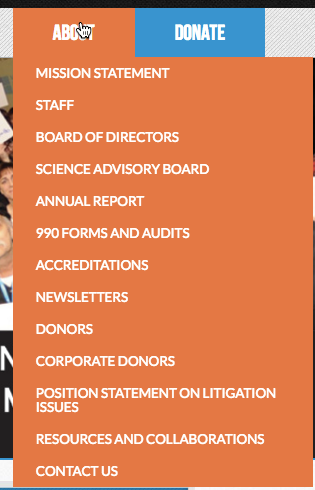
Look for a clearly labeled About section that says who they are and where the money comes from Mesothelioma: There are lots of liability lawsuits about this asbestos-related condition, so be aware of websites that are funded by attorneys who may only be looking for new lawsuits where they can take a cut. On the other hand, some such sites spend money to produce lists of resources that may truly be useful to you. As always:
- Keep your eyes open, think for yourself; be informed and engaged (e-patients)
- Never let anyone pressure you into anything.
- Any ethical site will have a prominent “About” page, like the one at right from the MARF site, saying who they are and where the money comes from. (Fine print at bottom of page doesn’t count – that’s slimy.)
- Having said that, here are some sites:
- Mesothelioma Applied Research Foundation (that’s their About menu)
- ADAO (asbestos disease awareness org)
- Heather’s page on mesothelioma.com (NOT patient-based as the name suggests – it’s an attorney-based site. The sponsor’s name is in fine print at bottom of the page)
- Multiple Sclerosis: Inspire.com’s MS community
- Parkinson’s Disease: see this post (Jan. 2012) with resources from Peter Schmidt of the National Parkinson Foundation.
- Preeclampsia Forum for patients that have or had preeclampsia or other hypertensive diseases in pregnancy. The website is informative and the forum (link below) is a great support and information network. – from SPM member Ileana Balcu
- Prostate cancer:
- UsToo.org is specific to prostate cancer.
- Health Unlocked is another great “community of communities.” (A friend just told me the patients in his prostate cancer community there often know things his doctors don’t.)
- Sarcoma: See discussion in this Nov. 2013 blog post.
- Skin cancer communities:
- Basal cell carcinoma
- EmpowHER: an actual basal cell community – sweet! Major props to my chorus buddy Kurt Boutin!
- PatientsLikeMe basal cell skin cancer (Thanks to Robert Dellavalle)
- Generic skin cancer
- American Cancer Society: http://csn.cancer.org/forum/145 (Thanks to Jamie Toth)
- Inspire.com: http://www.inspire.com/groups/skin-cancer/ (Thanks to SCAD sister Laura Haywood)
- Basal cell carcinoma
________
Places to find clinical trials:
When an accepted treatment doesn’t exist, or has failed, clinical trials for unreleased drugs can offer additional options. Some options:
- Clinical Trial Select
- FindMeCure.com
- Antidote.me (I used to be on their advisory board – see my page with their search widget)
Additional resources about many diseases:
SPM member and friend Larry Fagan MD PhD writes, “I received this info from the MedlinePlus folks at the NLM” [National Library of Medicine]:
- Local and National Support Groups by Disease (not necessarily online groups)
- Organizations that provide health information
- Directories of health and related services
He adds, “Elsewhere at NIH, these resources may also be helpful:”
An editorial comment about the above:
MedlinePlus uses specific criteria to determine which websites they link to for patient oriented medical information. Because of the home grown nature of some of the online communities many websites may not meet those guidelines, even though they can contain very useful information. (See Larry Fagan’s post on the NLM blog.)
Of course the internet is huge (duh) and nobody has a comprehensive list of websites, and besides, it’ll change by your next meal. So I’m publishing the list above, and as I said at the top, it has the following caveats:
Never assume that any one source is perfect –
no patient community, no book, no web site, no journal article, no physician, no nothing.
As ACOR founder Gilles Frydman said, “All knowledge is in constant beta.”
You are responsible for the information you gather;
check and re-check.
Dave,
I’d be delight if you’d list our clinical trial index as a resource. We don’t attempt to monetize anything. Our privacy policy is simple, straight forward and as it should be. http://clinicaltrialselect.org/privacy.php
Thank you.
Etienne Taylor
Comments submitted on another page. (All suggestions have been added to the post above.)
Daniel Hooker
May 4th, 2011 at 10:00 pm
This page at Dose of Digital does track of patient communities. http://www.doseofdigital.com/healthcare-pharma-social-media-wiki/
Though it looks to be a thorough list, it isn’t searchable (in a database sense) and doesn’t break down by supported disease/condition. What I do like about the list is that it identifies any controlling pharmaceutical interest in the community–something that often isn’t obvious from the sites themselves.
It would be great if we could figure out solution for getting what we need out of a database like this one. I do wonder if perhaps we could crowdsource it by contributing to Wikipedia or another public tool? I’d love to see something like this take off.
———
Andrew Spong
May 5th, 2011 at 9:45 am
Hi Dave
I curate a list of patient communities on StumbleUpon:
http://www.stumbleupon.com/stumbler/andrewspong/tag/patient-community/?grid
Andrew
@andrewspong
Best one I know: http://patientslikeme.com/
http://www.caringbridge.org/ is a nice one, too.
PS – Dave, this page is ONE example of many values patients want, ask for and need. I think we need ONE, “organized gang” of patients.. something like a “Society for Patient Interests” – to focus on only “patient” needs (in resources, organizing of resources, advocacy, education, empowerment, etc). This could be a project of the Society of Participatory Medicine, much like e-patients.net is. What do we think? How can current patient leaders spearhead such organization, if it’s agreed to be useful for patients?
PS,2 – Is this an idea I should propose here or elsewhere? I don’t want to crowd up this page with this discussion…
Ryan,
I used Caringbridge myself, but it’s not a community, right? It’s what you might call an individual journal or blog site, but not a place where people with a disease congregate and compare notes.
PatientsLikeMe most definitely is though.
You can propose anything you want on this site, but it has a smaller audience than the members’ listserv and the Society for Participatory Medicine…:) I doubt that one single massive patient group (which would, ultimately, include *everyone*) would be ideal for everyone, but who knows, others might agree.
My personal criterion is, can any given patient find info that will make a difference to them, and if so, how easy is it?
p.s. Stop thinking your comments are clogging anything up! :) Speak up! Express yourself! Be empowered.
btw, Ryan, revisiting your May 9 suggestion for a one-stop list of patient resources – why don’t you go to the Society for Participatory Medicine’s member listserv (I presume you’re a member) and propose starting that??
Excellent question, my friend! Once I get settled with finding a salaried job and the move (family completes moving into new place this Monday!), I’m planning to post a few ideas lingering in my head and get more active in the Society and patient advocacy/empowerment.
Quick Question, btw: I’m on the Patient Needs WG for Patients 2.0 / Health 2.0 in SF this year. We’re trying to discover what Patients need right now is. Any ideas? =) I like the idea of continuing along the patient empowerment movement, by striving to define what we feel ’empowerment’ should be and needs to encompass. I’m going to post this question on the listserv, as well.
I have a small but growing list here, organized by condition:
http://www.patientlovingcare.com/p/patient-care-links_14.html
Thanks, Elaine!
High five and sincere thanks for adding Encephalitis Global to your list of patient communities, Dave!
I’m sure you’re familiar with one of my favourite phrases… “I’m dancing as fast as I can!” Well, that dance somehow gets a bit easier when a friend joins in.
Again, our sincere thanks to you!
Here is a consumer health portal that aggregates highly focused content on both traditional and alternative medical treatments for chronic diseases. The first disease indexed contains over 6,000 medical journal articles broken down into the top 200+ categories for ulcerative colitis. There will be another 8 or so diseases added in the next three to four months.
What is unique about this index is that it was compiled using consumer search data plus over 20 custom medical databases (and a slew of algorithms) so that it represents the collective wisdom of millions of data points from patients and physicians. The information is near real time (updated a couple of times a month).
This is a new data content approach that aims to solve a few problems: a) Patients do not always know what questions to even ask or topics to search for b) Content sites become stale as information in medicine changes all of the time c) Information needs to be very focused and if there are only four articles on the topic, this approach can find those four articles and not a 1,000 unrelated articles.
This page is the disease overview http://mymedicalfinder.com/all-uc-topics and homepage is here http://mymedicalfinder.com .
In full disclosure, I am the co-founder. There is no commercial content indexed. Feedback is definitely welcome.
Thank you.
Dave,
We’d love it if you’d post a link to The Better Way Back. It’s a growing patient community for those faced with the decision to have spine surgery. We put those who have questions in contact with others who have undergone similar or identical procedures. Thanks!
Hi Matt – what sort of organization is this? From the website it appears to be a vendor / provider group. No problem with that of course – just need to be clear, and know what category to put it in.
Also, what’s the participatory medicine aspect of the service?
Well, Matt didn’t respond to my question, and in a separate post a LOT of docs said to be really cautious about back surgery. I clicked Matt’s link and then About Us, and although it’s a .org, it’s backed by vendors. His lack of dialog leads me to remove his URL.
People, social media is for dialog, not for post-and-run.
Here’s a patient community for people with crohn’s disease: http://crohnology.com/
CancerConnect.com is the best of both worlds. It offers comprehensive cancer information, organized by disease and stage. It is also a free social network for patients, survivors, and caregivers. Members can join one or more of the many “communities” offered.
Forum for patients that have or had preeclampsia or other hypertensive diseases in pregnancy. The website is informative and the forum (link below) is a great support and information network
http://preeclampsia.org/forum/
Hey,
There is a nice community regarding ‘Eye infections and diseases’ at Inspire.com. I have posted on it looking for answers to one of the condition I am encountering. It would be great if anyone could help in this.
Link: http://www.inspire.com/groups/eye-infections-and-diseases/discussion/hot-and-dry-eye/
Thank you,
WhatNext.com is a new online cancer support network developed with the participation of the American Cancer Society. WhatNext instantly connects people touch by cancer – based on a specific diagnosis – to peers and vetted resources that can help. We support patients, caregivers, survivors and loved ones.
At WhatNext, people are sharing the details of their cancer journeys as a way to help those who are newly diagnosed know what they might expect, what they might need and where they can get what they need.
Dave, I hope you’ll be able to list us. We would love for you to stop by and hopefully you’ll be able to share your incredible journey when you have some time. We’d love to hear your thoughts on how we’re doing!
Link: WhatNext.com
Thanks!
Karen
Thanks for having created this website, Dave!
The Amazon-L listserv is a community of women with breast cancer who have chosen NOT to do conventional treatment. For some, it’s a conscious choice, made after much research and soul-searching. Others, such as those with multiple chemical sensitivities, feel that it’s the only route available to them. Still others did standard treatment that failed them, so now they walk the alternative side of the medical street.
Our listserv exists primarily to support those using or wanting to use alternatives in order to heal. We do an enormous amount of research, mostly from alternative resources, but we also share conventional research related to a topic we’ve been discussing, or which surprise us. We discuss the research papers we find, seek other papers to corroborate or refute what we’ve found, and in some cases contact the researchers directly in our search to learn what might be useful against our disease. We share what our alternative practitioners have taught us, and support one another throughout.
We welcome those with breast cancer [and/or family members] who are interested in learning more about and/or following any of the
alternative protocols paths which have been successful against this
disease.
My own personal hope is that any woman who finds a lump in a breast
will join us before any kind of biopsy is done — that is, even before she knows if her lump is cancerous. That’s because all biopsies are not equal, and there are ways other than surgical to determine if a lump is cancerous or not.
Thanks again for being here, Dave!
Warmly,
Carole Berlin
Co-administrator of the Amazon-Alternatives Listserv
You can join by following the directions on our website
[www.amazon-alternatives.org] or by sending a message to the Listserv address
LISTSERV@LISTSERV.TECHNION.AC.IL
Leave the subject line blank
In the body of the message type SUBSCRIBE AMAZON-L Your Name
[using your first and last names in place of “Your Name”]
Hi, Dave
It’s been awhile since we spoke, but healthetreatment has gained terrific momentum in the past year, too.
Healthetreatment collects and displays self-reported health statistics and user-generated health content. Our mission is to help people around the world find new ways to feel better; to have a more productive conversation with their healthcare provider; and to have a better chance at an improved quality of life.
We’d be honored to be included in your list.
Thanks for the consideration.
encephalitis is really deadly if it is not treated early.:
Have a look at the freshest write-up at our personal web-site
http://www.healthmedicinecentral.com/where-is-your-gallbladder/
Hello Ivan! You may wish to visit the Encephalitis Global discussion forum where people discuss encephalitis, every day. Hope to meet you there!
Wendy, survivor, HSE 1999
Hello Dave – I appreciate what you are giving the world in regards to patient centered care and wellness. I am the founder of Health-Insurance-Forum.com I have been a medical biller for the past 5 years, after taking courses in medical coding and billing. At Health-Insurance-Forum.com the goal is to clarify and increase the transparency of the health insurance industry for patients as well as empower patients and encourage questions. With Health Insurance you can’t take anything at face value and we believe it should be treated as any other consumer industry – where people/patients/consumers are able to ask about things they don’t understand in an open discussion forum.
I have added your site to the HIF resources page.
Hi Dave,
Thanks for pulling together this list. Two more for you to add to the disease-specific. MyAutismTeam.com is a social network for parents of kids with autism. It has over 38,000 parents on it from all over the US and Canada. MyBCTeam.com is a social network for women who have been diagnosed (at any point in their life) with breast cancer. It launched 5 months ago and already has over 3,500 women. You can think about both of these communities as a cross between Facebook + Yelp + Pinterest -but focused specifically on each condition. They are free.
Many thanks!
eric
Are there online communities for people with celiac disease (Wikipedia)?
I’m compiling resources for someone I met, who was unaware that online patient communities exist. Suggestions, anyone?
Various thoughts –
— An informative short post on the Cases Blog, run by Twitter friend @DrVes: “3 million Americans are living with celiac disease” with a great 3:29 “infographic” style YouTube from the U of Chicago. (The first half is information, the second is a commercial about their work – including their goal of finding a cure in 10-15 years. That’s valuable to patients to know, because there’s also talk about a possible pill to treat it … a pill would be great for those who don’t want to live with a gluten free diet, but a cure is the best of all worlds.)
— I’m not clear about the relatedness (or not) of Crohn’s Disease, other IBD (irritable bowel disease) and everything else. I know about the ImproveCareNow “learning health system” for children with IBD, but celiac isn’t included.
— On the C3N site I found this discussion among some patients. It’s the internet in all its glory: misspellings and sloppiness with valuable information in the stream. Real people exchanging real experiences, including their feelings.
— I’ve also started using Symplur.com’s hashtag feature to find Twitter discussions. Here’s the one for #celiac.
— A related hashtag is #glutenfree, with a ton of traffic – over 1500 tweets a day, largely about “GF” foods (gluten free).
Today’s Boston Globe has an article about an apparently promising vaccine to eliminate the disease. Many open questions, but apparently worth following.
Twitter magic –
From @CRGonzalez: Try Inspire.com @TeamInspire
And a few minutes later that led to this, FROM @TeamInspire:
Check out the Inspire/Celiac Central Support Community… We partner with @CeliacAwareness.
Good afternoon,
We are the UK’s charity for people with coeliac disease and dermatitis herpetiformis.
We have Facebook and Twitter pages available at http://www.facebook.com/CoeliacUK and http://www.twitter.com/Coeliac_UK
Both of our social media channels have a great following and are places where help and guidance, ideas, recipes and thoughts are all shared on a daily basis.
Please take a look and visit our website – http://www.coeliac.org.uk – for more information.
Thanks! Looks like useful resources – do you have patient community there, discussing things? I couldn’t tell, at first look.
Hi Dave. Our social media channel participants tend to be a mix of patients, friends and families of those with coeliac disease and those looking for a diagnosis, but we don’t have any statistics on number of patients.
you may also add European Cancer Patient Coalition in Brussels Belgium a European umbrella organization with 340 members in 42 countries (USA too!!) our website is under reconstruction http://www.ecpc-online.com
Admiring the persistence you put into your website and in depth
information you provide. It’s great to come across a blog every once in a while that isn’t the
same old rehashed material. Great read! I’ve bookmarked your site and I’m including your RSS feeds to my Google account.
My homepage company of heroes 2 patch cracked (Valarie)
Hi Dave -looking for a community discussing the treatment of uveitis. My husband suffers from this condition. Specialist after specialist canno tell us what has caused this and he has been on prednisone and methotrexate for almost 10 years.
Thanks Dave for all you do, the work you do is truly amazing.
Dave and friends:
My father has just been diagnosed with AML (Acute myeloid leukemia) and I am wondering if there are any online patient communities out there I can connect him with? He is going in to City of Hope today for additional diagnostic testing and to see what his treatment will be and when it will start. I’ve heard this disease is aggressive so am hoping that this has been caught early. I also wanted to get engaged as a family member so any recommendations for sites, books, articles to read would be greatly appreciated.
Thanks!
Inspire has excellent patient forums… I highly recommend it! http://www.inspire.com/groups/leukemia-lymphoma-and-myeloma/
I’ll tweet it – best wishes.
Appreciated Dave… Encephalitis Global’s forum has been associated with Inspire since 2008; we continue to be delighted with their management style.
There’s an organization called CHERUBS for people born with Congenital Diaphragmatic Hernia. It was started as a way for our parents to connect but has since grown as a way for survivors to connect as well. They hold fundraisers for research and overall bring awareness.
Thanks! I’ll add it to the list the next time I’m in there.
You might want to add rawarrior.com!
Cheerio!
Elizabeth Riggs
If Facebook communities can be included, our public site on Facebook is facebook.com/clusterheadachesupport. From there, members can join a private Facebook community as well.
Thanks, Dave.
Of course – thank you!
What, you think I’d say “Nice try, but I don’t think patients should be allowed to connect on Facebook”? Ha ha ha ha ha … :-)
Thanks very much. I need to get in to the back end of this page and edit the list!
Hi Dave,
There’s a nonprofit organization called Human Health Project (HHP).
HHP provides a free, noncommercial forum for individuals anywhere to connect and build community while supporting each other. We believe health of individuals worldwide is a human right for all. (I’m a current volunteer.)
Sounds fascinating – I’ve wondered if such a thing would ever get started, Nancy. I’d like to explore sometime!
I have found Inspire.com to have the best community for my rare cancer, Pancreatic Neuroendocrine Tumor. Over 500 people which is pretty significant considering. And very active with many daily updates from many of them.
Hey e-Patient Dave, What do you know about patient portals with physician offices? Looks like with Blue Button we can easily view our medical data, download it or send it to another doctor…at least in some physician offices.
What do you mean by “what do I know”? I advocate for the cause in speeches and blogging, and I write books, and I’m trying to do some consulting work. So, sadly, I don’t have nearly enough capacity to study what current reality is on the front lines … wish I did!
Hi Dave,
There is a new network of communities for people with many diseases, many are rare, some like lupus and Fibromyalgia and the community for caregivers are not so rare. It’s a huge network called Ben’s Friends. Each community is laid out a bit like Facebook, in that you have a home page and some info about yourselves, then people can leave messages on your page, and people start “discussions” that others reply to. There is no news feed like Facebook. I belong to 4 of Ben’s friends communities.
This is just a partial list of the illness communities you can join:
Learn more at http://www.bensfriends.org. I wish I had a way to include the link to each site here, but the link I just gave, if you go there, look on the right side of the page where the list of diseases are, and then click on the disease you are interested in, and you will be taken to that community’s website. They are getting all sorts of recognition and awards, and lately I have even seen doctors joining because they get so much information from the patients there, that is not not in a textbook.
Acute Disseminated Encephalomyelitis (ADEM)
Addison’s Disease
ADHD/ADD
Adrenoleukodystrophy (ALD)
Amyloidosis
Arteriovenous Malformation (AVM)
Ataxia (International)
Ataxia (U.S.A.)
Atrial Septal Defect
Brain Aneurysms
Caregiver Support Community (FB)
Charcot Marie Tooth (CMT)
Chiari Malformation
Chronic Inflammatory Demyelinating Polyneuropathy (CIDP)
Crohn’s Disease
Disabilities
Eagle Syndrome
Ehlers-Danlos Syndrome
Erythromelalgia
Fabry
Fibromyalgia
Glossopharyngeal Neuralgia(GPN)
Guillain-Barre Syndrome (GBS)
Lupus
Lyme Disease
Multiple Myeloma
Myositis
Narcolepsy
Nephrotic Syndrome
Primary Sclerosing Cholangitis (PSC)
Psoriatic Arthritis (PsA)
Sjogren’s Syndrome
Synovial Sarcoma
Traumatic Brain Injury (TBI)
Trigeminal Neuralgia (TN)
Ulcerative Colitis (FB)
Von Willebrand’s Disease (VWD)
Hi Dave,
HealthUnlocked has a number of patients communities run by evidenced based organizations.
Thanks!
Joel
Thanks, Joel!
What specifically do you mean by “evidence based organizations”? Your About page https://healthunlocked.com/about says over 500 patient organizations – do you mean 500 communities (“PAGs”) in your site, or something else?
I’m open to business models that work for everyone – as most people know, I’m not anti-business – but the first thing patients are taught about health on the internet is “Who’s behind the site? Where’s the money coming from?”
Again, I’m not anti-business, but people do need to know. And I didn’t readily find anything specific, so I’m asking. :)
Hi Dave,
Sorry for the delay in responding. I didn’t see you had replied!
All HealthUnlocked communities (with the rare exception) are run and administrated by partners. Those partners are typically charities with a focus on a particular disease or condition. We aim to partner with those organisations that have an evidence-based approach to health (particularly with regard to their condition-focus). There are over 500 partners in various parts of the world and in a few different languages, the majority being English speaking and from the UK, though we are now beginning to offer the communities (for free) to US organizations as well.
For example-
• You can see a community focused on Rheumatoid Arthritis here: https://healthunlocked.com/nras
• Or a community focused on helping people understand the science behind health claims (particularly in the media) here: https://healthunlocked.com/healthyevidence
• Or a community focused on wellness (running) here: https://healthunlocked.com/couchto5k
The question about finances is a good and appropriate one. Sorry you couldn’t see it on our site. We’ve got a link in the footer, ‘Business model’ which explains this: https://healthunlocked.com/about/business. In short we’ve created technology that helps connect physicians and patients, which generates income and we occasionally help with research.
I hope that helps
Interesting reply, Joel. Yes, how you generate income is indeed unusually clear, once someone finds it. :-)
In my travels I find that while industry insiders and general business people know what a “business model” is, a lot of the general public don’t, so it might help a bit to say something more explicit like “How we’re funded.” (I don’t want to overdo the subject – just pointing out that consumer/patients tend to have more everyday vocabulary, so as I say in the book, “Clarity is power.”)
One more question – do you vet each community and engage with them ongoingly?
I do applaud what seems to be a thoughtful and intelligent business model. I know first-hand that it takes real work to generate real value for people in need AND stay in business.
Hi Dave,
That’s a great point. Being clear is very important to us and using a more colloquial term or phrase is a good idea.
We do vet our partners. We also help them get their community going, mostly through resources / materials we provide. Once the community is up and running we try to be ‘non-editorial’ and let the community admins, who are the experts of their condition area, run the community. We offer ongoing support as and when it is needed. We also offer a community solely for admins of communities so they can seek advice and learn from one another.
If you’re interested in hearing more about HealthUnlocked I’m sure our founder, a former orthopaedic surgeon for the NHS, would be happy to have a chat.
Thanks for the great questions and advice. Feel free to keep the conversation going. My email is joel [at] healthunlocked [dot] com.
Myeloma Beacon http://www.myelomabeacon.com/forum/
Smart Patients https://www.smartpatients.com/partners/imf
MMRF CoMMunity Gateway https://community.themmrf.org/
MyGlu.org is the only online type 1 diabetes community that does real-world research through online surveys and polls. We also offer a supportive forum and content on a variety of research and lifestyle topics. We’d love to be added to your list!
Hey Dave,
Thanks for creating this site!
I learned to reverse Crohn’s disease (which I was told was impossible) and love helping other people replicate this process.
As a result of that journey, I actually co-founded DaoCloud.com – the network for wellness. It’s an online community where you can find trust wellness resources, information, and professionals. It is an excellent resource that other readers of your site will certainly appreciate.
Hi, Eric. I looked at the site and it violates my very first principle of judging unknown content on the web: there’s nothing that says who owns and funds the site. Without that, I can’t recommend anything. So I’ll leave this comment here but recommend people avoid the site, as an example. If you add that to the site, e.g. in an About Us or Who We Are page, come back and let me know so we can update this thread.
The problem is, the internet’s a big messy place with all kinds of scams, so if you want to be seen as “not a scam” you need to make clear who’s funding it. I hope you understand.
Hi, Dave!
Thank you so much for this list of patients’ communities! It will be of utmost importance for us at FindMeCure too.
By the way, I believe FindMeCure would be a really useful addition to this list. We are a patients’ platform providing information about more than 90% of the clinical trials worldwide as well as free assistance in the application process for each suitable trial.
Here is the link to the platform. I would be really grateful to learn what you think about it! https://www.findmecure.com/
Thanks,
Vess from FindMeCure
Well, yes and no. From what I see on the website, FindMeCure is not at all a patient community, right?
So I’ll add it to the subhead “Places to find clinical trials.” Thanks!
Thanks for adding FindMeCure to the list of “places to find clinical trials”! This is what I meant too, my apologies if it wasn’t clear enough.
Indeed, FindMeCure is a platform that supports patients in their search for clinical trials, not a community itself.
Thanks once again!